


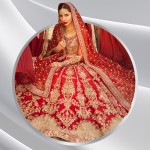
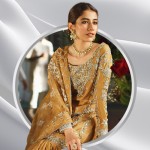
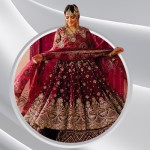
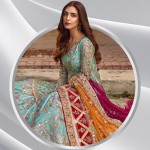

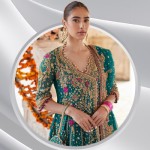
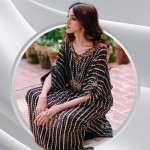
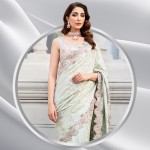





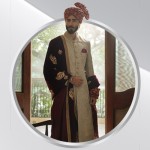





If you have ever walked into a bridal atelier in Lahore or Karachi, picked up a heavy bolt of handloom Banarsi silk, and tilted it toward the light, you already know the magic of Dhoop Chhaon.
In one second, the fabric looks like a deep, smoldering plum. Then you take a step, the pleats catch the light at an angle, and suddenly a flash of antique copper or emerald ripples across the folds. Literally translating to "Sunlight and Shade," Dhoop Chhaon (or shot silk) has been the ultimate signature of royal South Asian couture for centuries.
Until now, though, experiencing that magic online was impossible.
When we first launched the Zarighar Color Directory with over 5,600 shades, our goal was to give brides the largest digital shade card in the world. However, as masters of physical garment construction, something bothered us: a bride doesn't wear a flat square of digital paint.
A flat hex code on an iPhone screen cannot tell you how a crimson shade will trap shadows inside the deep folds of Royal Micro-Velvet, or how Tissue Organza will catch the warm glow of a ballroom chandelier. When you are commissioning an heirloom bridal outfit from London, Houston, Toronto, or Dubai, "guessing" how a color will behave on real fabric simply isn't good enough.
That is why we went back to the drawing board and built a live 3D Fabric Physics & Dhoop Chhaon Simulator right inside the Zarighar Color Suite.
How Dhoop Chhaon Actually Works: The Dance of Taana and Baana
To understand why two-tone silk looks so alive, you have to look at the loom. Traditional handwoven silk is made by intersecting two sets of threads:
- The Taana (Warp): The lengthwise threads stretched tightly across the loom.
- The Baana (Weft): The crosswise threads woven back and forth through the warp.
When both threads are dyed the exact same color, you get a solid shade. However, when a master weaver pairs a Maroon warp with a Burnt Gold weft, something extraordinary happens optically. Because silk fibers have a natural triangular prism-like sheen, the crests of the folds facing you directly reflect the Warp (Taana) color, while the curving edges of the pleats—where light grazes the fabric at an angle—reflect the Weft (Baana) color.
In our Color Comparison & Dhoop Chhaon Studio, you don't just look at two colors side-by-side anymore—you actually weave them together.
- Pick Any Two Shades: Load any two colors from our 5,605+ shade archive (say, Peacock Blue and Rani Pink).
- Swap the Loom Instantly: Click the Thread Swap (⇄) button to flip the Taana and Baana. You will immediately see how a Peacock base with a Pink sheen looks completely different from a Pink base with a Peacock sheen.
- Inspect the Thread Grain: Turn on the 6x Optical Weave Inspector Loupe to zoom right into the macroscopic thread structure and see how the silk fibers and metallic zari threads interlock.
One Shade, Six Completely Different Dresses: Choosing Your Fabric Base
Anyone who has worked with textiles knows that the exact same dye recipe will look completely different depending on the fabric you dip into the vat.
When you open any shade in the Zarighar Color Suite—or compare shades in the studio—you can now switch between 6 physics-calibrated South Asian couture fabrics:
- Pure Banarsi Katan Silk: High-luster, liquid-like drape with strong two-tone iridescence that catches every movement on the stage.
- Royal Micro-Velvet (Makhmal): Deep, plush light-trapping valleys that make jewel tones (like emerald, maroon, and midnight blue) look intensely dark in the creases while glowing softly along the edges.
- Tissue Organza: Crisp, architectural folds with a sheer, translucent glow and tiny metallic micro-sparkles.
- Raw Silk (Karandi): Features an organic horizontal and vertical slub texture with a noble, matte diffusion—perfect for structured peshwas bodices, tailored sherwanis, and formal joras.
- Pure Chiffon: Featherweight and fluid with delicate, billowy ripples.
- Matte Crepe: A heavy,Zero-sheen pebbled texture that absorbs light for understated, modern elegance.
You can even change how the garment is pleated. Toggle between Royal Fluted Lehenga Pleats, a Cascading Dupatta Ripple, or crisp Architectural Box Pleats, and adjust the fold relief from subtle silk waves to dramatic, sculptural couture folds. Want to see it as a full outfit? Switch the silhouette mode between a Flared Bridal Lehenga, Imperial Anarkali Gown, Heritage Banarsi Saree, or a Groom's Royal Tailored Sherwani.
Layering the Bling: 24K Zardozi, Silver Tilla, or Gota Patti?
A bridal fabric is only half the story; the embroidery changes the entire visual temperature of the dress. A cool-toned pastel lilac looks icy and modern with silver work, but turns warm and regal when layered with antique gold.
Directly on the 3D canvas, you can overlay four authentic hand-embroidery wirework styles over the scalloped daaman hemline and jaal lattice:
- 24K Antique Gold Zardozi: Heavy twisted bullion wire with a rich, warm gold bloom.
- Silver Tilla Shimmer: High-shine polished silver metallic filament in a classic diamond jaal and starburst motif.
- Rose Gold Gota Patti: Crushed metallic ribbon appliqués with a soft coppery-pink warmth.
- Mughal Coiled Dabka: Intricate French wire spiral medallions that catch pinpoint highlights.
The Ultimate Venue Test: Daylight vs. Ballroom Chandeliers
Here is a heartbreak that happens far too often: a bride chooses a color under the bright fluorescent tubes of a boutique, only to step into a dimly lit, warm hotel banquet hall on her Baraat night and realize her dress looks muddy.
Light temperature changes everything. That is why we built a 360° Interactive Lighting Compass Orb and 4 Calibrated Venue Environments right into the simulator:
- Natural Outdoor Daylight (5500K): Crisp, true-to-life color rendering—essential if you are planning an outdoor garden Nikkah, daytime Mayun, or Mehndi.
- Ballroom Crystal Chandelier (2700K): Simulates the warm, candlelit golden glow of evening Baraat and Valima banquet halls.
- Golden Hour Sunset (3200K): Recreates that rich, amber late-afternoon grazing light for your outdoor bridal portrait shoot.
- Photography Studio Flash (6000K): High-intensity runway and wedding photographer strobe light, showing you exactly how the silk sheen will bounce back into the camera lens.
Just drag your finger or mouse across the fabric—or hit the Auto-Sweep button—to move the spotlight 360 degrees around the pleats at a smooth 60 frames per second.
Save Your Creation: Export Shimmer Videos & Dhoop Chhaon Colorway Cards
Planning a wedding is a family affair. Once you have discovered a breathtaking two-tone combination or tested a shade under chandelier light, you don't need to take blurry screenshots.
- Record a 360° Shimmer Video: With one click, record an MP4/WebM video of the light sweeping across your custom silk drape to drop straight into your family WhatsApp group.
- Download an Archival Dhoop Chhaon Colorway Card: Generate a high-resolution presentation card (in Imperial Velvet Noir or Royal Ivory Parchment) complete with your Taana and Baana hex codes, fabric specs, a scannable QR code that reloads your exact live simulation, and an official Zarighar reference code.
- Send Straight to Our Master Stylists: Love what you wove? Click the WhatsApp Atelier Concierge button, and it will automatically send your exact warp shade, weft shade, fabric choice, and zari preference directly to our bridal consultants so we can bring it to life on the loom.
Ready to Test Your Dream Bridal Shade?
Stop imagining how your wedding colors might look on real silk and start seeing them in motion.
Explore the 5,600+ Shade Directory or jump straight into the Dhoop Chhaon & Color Comparison Studio to weave your first two-tone silk drape today.
(Stay tuned for Part 2 of our series, where we tackle the #1 fear of every bride: "Will this color wash me out?"—and show you how our Live Camera Skin Calibrator and Rang & Roop engine match fabrics to South Asian skin undertones!)
Leave a comment